
Talk it through together
You already have separate briefings; what you might lack is one room where the full story is allowed to be told.
If you want a place to test how your current narratives sound when finance, operations, and governance sit at the same table, you may not need another framework. You may simply need a candid, technically grounded conversation that treats constraints as design inputs rather than inconveniences. Results may vary, and past performance does not guarantee future results, but clearer shared reasoning usually travels better through difficult cycles than polished optimism.
Start conversationTurning parallel briefings into one shared discussion
Instead of chasing consensus on every detail, we focus on building a shared, technical picture of reality that each function can challenge without translation.
Cross-functional discussions about industrial finance often start with good intentions and end with carefully worded summaries that leave key tensions untouched. On this page, we focus on how to make those tensions visible without turning every meeting into a stalemate.
Identify shared questions
Clarify which capital and risk questions truly require input from finance, operations, and governance instead of scattering them across separate agendas.
Put constraints side by side
Lay out constraints from each side on a single page so that trade-offs are explicit rather than buried in separate reports and side conversations.
Align on relevant scenarios
Agree on a small set of scenarios that everyone recognises as plausible and worth planning for, rather than debating probabilities in the abstract.
Document the real conversation
Capture the discussion in concise notes that preserve disagreements, doubts, and trigger points instead of smoothing them away for optics.
A simple way to start on your own

1
State the intent
Begin by writing a one-page note that states, in plain language, what your current capital and risk posture is trying to achieve over the next several planning cycles. Avoid slogans and focus on concrete aims, such as maintaining specific buffers, protecting optionality for future moves, or supporting known operational shifts. This becomes the reference point for every subsequent discussion.
2
Collect the constraints
Next, ask each function to list its non-negotiable constraints on a shared document. Finance might include covenant limits and liquidity thresholds. Operations might highlight maintenance windows, staffing realities, and supplier dependencies. Governance might add approval timelines and policy boundaries. Seeing these lists side by side reveals where current expectations are misaligned before stress arrives.
Trace the responses
Then, sketch a small set of scenarios that matter to everyone in the room. For each, trace how decisions would actually move through your organisation: who would need to act, with what information, and on what timescale. The goal is to identify points where your current processes would lag behind events, not to produce a perfect forecast.
Record the discussion
Finally, document what was agreed, what remains contested, and which signals should trigger a return to the table. Include doubts and minority views rather than smoothing them away. This record will not remove uncertainty, but it will give future teams a clearer understanding of how today’s posture was chosen and where you expected pressure to appear.

Where finance, operations, and governance finally meet
Most meetings give each function a separate slot; we are interested in the uncomfortable
middle where their assumptions collide.
You are probably used to conversations that split your world in three. Finance talks in
terms of ratios and covenants. Operations talks in throughput, downtime, and safety.
Governance talks in policies, approvals, and minutes. Each group is coherent on its own;
together, they often talk past each other. This page exists for the gap between those
conversations. We focus on the junction where industrial finance, plant realities, and
decision processes collide over several planning cycles. Instead of pretending these
domains neatly align, we assume there will be friction, delays, and mismatched
expectations. Our stance is simple: if a decision matters enough to shape your capital
commitments and risk posture, it deserves a single, shared narrative that all three
groups can recognise as accurate. Here we outline how you can move from parallel
presentations to a joint, technically grounded discussion. We emphasise constraints,
timing, and documentation rather than slogans. The aim is not harmony; it is a clearer
view of where your current structures work, where they are fragile, and where small
changes could materially improve how you respond when conditions are less forgiving than
your upside case.
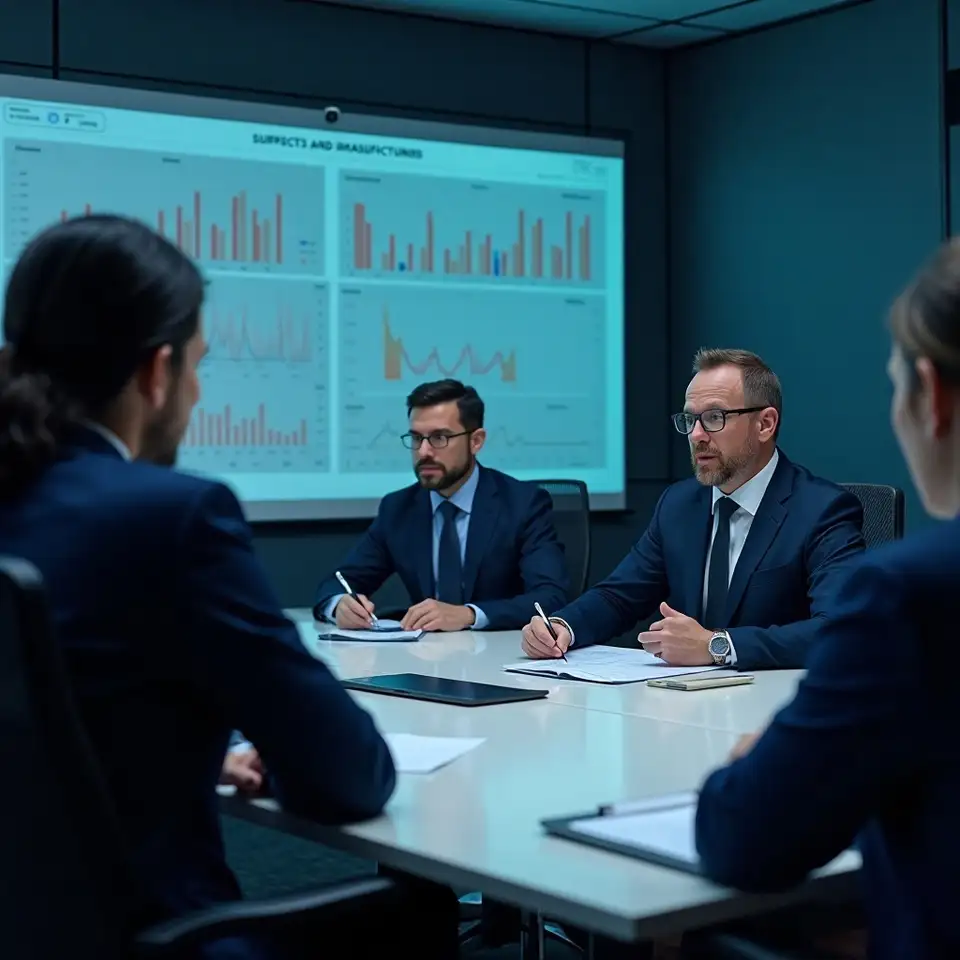
Designing conversations that match the weight of your decisions
From polite abstractions to specific, shared constraints
When you put finance, operations, and governance in the same room, the conversation often defaults to polite abstractions. Everyone recognises the friction, but nobody wants to be the one to spell it out. We take the opposite stance. Start with the friction. Name where targets conflict, where processes are slow, and where covenants or policies constrain options more than the slide deck admits. Only then does it make sense to talk about structures or adjustments.
This approach can feel uncomfortable at first, but it tends to reduce surprises later. By tracing how decisions actually move through your organisation, you can distinguish between risks that are genuinely outside your control and those that stem from your own timing, information flows, or incentives. The goal is not to remove disagreement; it is to make it explicit enough that future choices reflect conscious trade-offs rather than accumulated habits.
List constraints from each function on a single, unglossed page.
Map where decision delays, not capital, are the binding limit.
Write down trade-offs in plain, technically precise language.

Cross-functional clarity without theatrics
Bringing finance, operations, and governance into one structured, sceptical
conversation.
What makes this cross-functional perspective different
Most material about industrial finance focuses on instruments or metrics. We focus on the conversations that decide how those tools are actually used when conditions become awkward rather than ideal.
Shared reality across finance, operations, and governance
We start with your frustration that key decisions are discussed in separate rooms. Our focus is on building a shared, technical picture of reality that finance, operations, and governance can all recognise, even if they disagree on the right response. This reduces the need for translation and makes hidden tensions visible early.
Minimalist, repeatable decision structure
Instead of adding another complex framework, we rely on short, structured notes and a small set of recurring questions. What are we trying to achieve. Which constraints are real. How do decisions actually move. This minimalist approach is easier to maintain and revisit as teams and conditions change.
Focus on timing and real decision speed
We pay close attention to timing: when information arrives, when committees meet,
and when counterparties can realistically respond. This helps distinguish between
scenarios you can actively manage and those where events would outrun your current
processes, even if capital appears available on paper.
Sceptical, risk-aware framing of long-horizon choices
Our stance remains cautious and sceptical. We avoid overconfident claims and treat
lines such as results may vary and past performance does not guarantee future
results as real design constraints. The aim is not to remove uncertainty but to make
your tolerance for it explicit, documented, and open to challenge.